Pages

Tuesday, October 11, 2011

Our Special Friend

A misty September morning


The first summer after I returned to this area, I made the mistake of getting attached to some of the deer.  In particular, two does stood out that always
traveled together. The one mother was ever vigilant and always protective of her twin fawns.  The other doe would graze with her fawn and never seemed to be concerned for her safety.  As could be predicted, that doe disappeared the first day of gun season.  The other mother deer showed up with what were obviously injuries due to a collision with a car. All three fawns were with her, but one of hers also seemed to have a seriously injured leg.

As winter came, the doe continued to get thinner in spite of our putting food out for her, and her difficulty in walking continued.  Her fawn's leg was thicker in the injury area so it was easily identifiable. Eventually, the weakened doe subcombed to fate and disappeared, but the three young ones continued to graze in the area. The last time I saw them, it was nearly spring.  The young deer were crossing the road, and one was dragging a leg as it attempted to walk. Such a sad ending for these beautiful creatures.

Well, I did it again, I became attached to one of the does that frequent our area.


Let me introduce "Courage" our doe who only has three legs that she can walk on.  Her right front foot has been badly injured.

"Courage"

As a breast cancer survivor who has seen some rough times, I really appreciate the strength, determination and courage that this deer has shown in her struggle to raise fawns, survive severe winters and just to travel about.

It was late 2008 when Courage first came to my attention.  She was attempting to walk on only three legs. I'm sure she had been in our field many times, but now with her huge handicap, she stood out.  What happened to her is unknown.  Perhaps a trap or some kind of injury to her leg resulted in this life changing event.  Every time she attempted to walk on her three normal legs, she would slip and nearly fall. It was so sad to watch her, especially when the ground was wet.  Her struggle just to move became even more difficult. The other deer left her behind and soon she was only seen alone.

In early summer of 2009, I was surprised to see her appear in our field with a tiny fawn.  Future sightings of her were alone.  Maybe she wasn't strong enough to feed her baby or protect it from predators.  We watched her throughout the season marveling that she hadn't been hit on the road. Courage seemed to like to stay close by and over time, paid little attention to our comings and goings.

The winter of 2009-2010 was especially difficult with deep snows.  I stopped measuring in early January when we had exceeded 100 inches.  Although I do not have an exact measurement for the area around our house, my guess is that we received at least 175 inches before winter ended.

As usual, Courage had disappeared as soon as hunting season began during the previous fall.  We feared the worst for her and couldn't imagine how she could move about enough to forage for food in such deep snow. To our delight, she reappeared in early summer with twins.  Unfortunately, it wasn't long until she was bringing only one fawn to graze in the field with her.

Last fall, with doe season in progress, we hoped that with only three useful legs, she would not fall victim to a hunter looking for an easy kill. In early spring I was overjoyed to see that once again she had survived.  This year I began documenting her journey after my husband saw her and took pictures of her, early one morning, with her tiny twins. What a nice surprise she presented us with.


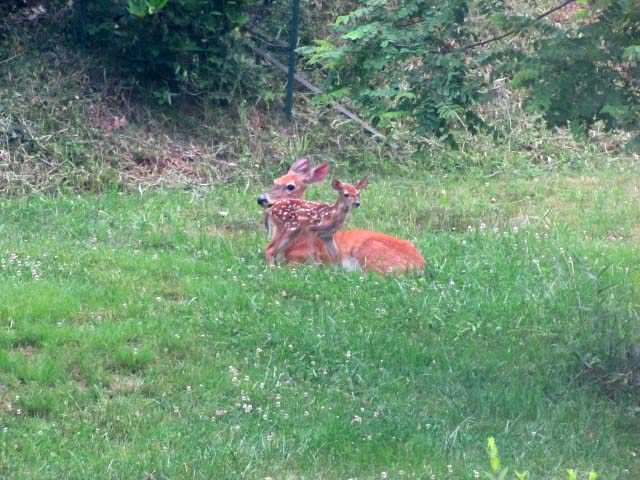
These are her fawns on June 15.  In the photo below, one of her tiny fawns nuzzles her looking for some food.


By September 24, they had become quite active and like all siblings, delighted in racing about and chasing each other.  Here is a quiet moment while Mom rests and they refuel for another playful episode.


They were growing up, but just like toddlers, they still wanted the comfort of the closeness with their mother.


Courage seemed to fatigue easily and to rest more than I had ever noticed previously. This picture was taken in mid September and her fur was changing on the top of her back to a deeper brown for winter.


Here she grooms one of her babies.  As I watched her, I wondered what it must be like for her.  She is a deer that always travels alone, unable to keep up with the others. Now she has two precious babies that she watches over and that go with her almost everywhere.

Sadly, that was the last time that I saw her with both fawns. By late September, she did not come around for several days.  While my husband was mowing, he came across a dead fawn which further increased our concerns for the safety of Courage and her little family.  We watched, hoping to see her emerge from the woods with both babies.  Finally, we saw her but only with one fawn.

Courage began to stay closer to the house in an area bordered on one side by woods and on the other by a seven foot fence that keeps the deer out of the flower and vegetable gardens.  One day, early last week, we looked out to see her fawn peering around inside our flower garden while it's mom continued to graze in the grassy area outside of the fence. We watched as the fawn deftly squeezed through a hole at the bottom of the fence.  My husband had not totally finished repairing it after a bear had bashed its way in earlier this summer.


Over a period of several days, we enjoyed watching the antics of the fawn while its mom waited outside, lying up against the fence.


It sampled the hostas and oh so many tasty plants.  For a little deer, this must have been like Christmas morning is to human children.


On Sunday afternoon with autumn in full color, heavy traffic began to appear on our road.  We must have been part of a back roads autumn tour. Groups of motorcycles went by and the car and other vehicle traffic, in both directions, was incessant. Neither my husband nor I could remember seeing so many people in our area.  I'm sure that it would have been very difficult for any animal to safely cross the road.

Then, about midafternoon our fawn appeared alone.  It slipped into the fence just as it had for so many days and began sampling the hostas. The young deer looked around as if expecting its mom to appear. Finally, it lay down against the inside of the fence next to the spot where it's mother had been lying on the outside of the fence, the afternoon before.  It stayed for a couple of hours alternately looking at times as if it expected its mother and at others, dozing.  Meanwhile my husband also dozed for a while on the swing just about 40 feet away.  Finally, the fawn left and headed into the woods.

We were gone on Sunday, but we have seen the fawn twice today.  Both times it was inside our fence, and both times it seemed agitated and afraid, staying only briefly. Unfortunately, this story of another doe does not seem to have a happy ending either.

Wednesday, September 14, 2011

THE COLORS OF SUMMER


Summer warms the body, feeds the soul and delights the senses with a kaleidoscope of colors. With fall evident all around, I love to look back through the photos that I have taken, at the vivid colors of summer
when every creature and plant wears its finest.


The daylily, nature's colorful trumpet, calls forth the summer
and it's lovely breezes.


A blue dasher dragonfly lands on a pink lotus bloom at the 
North Carolina Museum of Art in Raleigh, NC.  What brilliance of color, 
what a delight on a hot summer day.


Golden fritillary butterflies drink nectar from rose colored Sweet William flowers 
just as they have for centuries in early summer gardens.


The four-eyed milkweed beetle gives a clash of color as it
treads across the bloom.


Black-Eyed Susans look like cheery droplets of sun with night colored centers.


A tiny spring peeper sits quietly on the unopened blooms of a sedum.
Earlier in the summer, his cheerful call went on for hours.
What a wonderful nighttime song!


So many patterns, such tranquil colors, as blue and yellow converge to paint a glorious picture.


    Like a summer dandelion, the goldfinch in all his glory brightens
the green dominated scene of a midsummer wetland.


A speckled robin fledgling, not yet dressed in his brown tuxedo, sits precariously on a magnolia branch.


A burst of cheer, a droplet of color, hidden deep in the shadowy woods.


Gold, the color of spring daffodils, summer sunflowers, and autumn goldenrods, is truly one of nature's brightest and most spectacular shows. 


Gentle browns, the newness of life make summer seem so exciting
and full of hope.


The blues of the sky, of birds and water give us tranquil pauses in a busy day.


Variegated greens and vibrant blues make a shady spot seem extra refreshing.


The green leaves of pond lilies make a cozy little nook for a little green frog.


With mountains softly silhouetted in shades of blues and purples,
the grasses sway with each summer breeze. 


Summer, there is no other time that creates such joy, provides amazing bounty, and so delights the senses.

Saturday, June 25, 2011

Springtime in the Beautiful Knobs of Kentucky


During the week of April 17 to 23, we travelled to the Knobs Region of Kentucky. The hills are called The Knobs because they are cone-shaped with steep sides and altitudes generally less than 1000 feet above sea level.  The Appalachian Mountains lie to the east.


Woodland Flowers


We took a short hike in the John B. Stephenson Memorial Forest Nature Preserve to Anglin Falls, an area located near Berea, KY. The woodland floor was alive with a special floral covering of spring flowers. These are some of the things that we saw while hiking to the falls.


The Trail to Anglin Falls


violets

Long-spurred Violet

This little violet is called a long-spurred violet because of the long spur on the bottom petal. It can also be distinguished by the purple spots on the petals.  


Canada Violet

Violets are the flower that seem to proclaim that spring has truly arrived. This is the Canada violet.  It has a yellow tint to the base of the petals, and if you were to turn it over, the back of the top two petals is purple. 


Woodland Phlox and a Tiger Swallowtail


This tiger swallowtail is enjoying a sip of nectar from these native woodland phlox.  They are sometimes called wild sweet williams.


Dwarf Crested Iris

The dwarf crested iris is a showy, native plant that grows close to the ground.  It is visited by hummingbirds, and like native columbine, provides an early source of nectar for them.  


Jacob's Ladder

Jacob's ladder is a native plant that gets the "ladder" portion of it's common name from the opposite leaves that look like a ladder.  My first memories of it are those that I saw in my own grandmother's garden.  The plant's fragrance is reported to be attractive to cats,  and they will roll in it just as they do in catnip.


trilliums

White Nodding Trillium


No spring woodland trip would be complete without trilliums to admire, and these woods provided plenty. A common name for them is Wake Robin so called because they appeared at about the same time the robin returned.  They can be eaten and are used medicinally for diarrhea.  Native Americans used them as an aid for childbirth.


Sessile Trillium


The sessile trillium is also known as the toadshade trillium, the toad trillium and sweet Betsy.


Red Trillium


The red trillium is sometimes known as the stinking trillium.  Some people describe its smell as similar to that of a wet dog.


Redbud trees and dogwoods along the way.


This is a bird's nest that we spotted just off the trail. It is probably a Baltimore Oriole's nest although there are several other birds that will build a hanging nest.


As we neared the falls, the trail became narrower with some rocky area to traverse.


We saw this pickerel frog near the falls.  Click on the link  below to hear his call which has been compared to a snore.  On the left side of the page, click on the family tab and then on Ranidae.  Then click on Pickerel.


Beautiful wisps of orange and yellow, these native columbines were blooming
 among the rocks.


This is Anglin Falls in April, a hike worth taking. 


      Now every field is clothed with grass, and every tree with leaves; now the woods put
forth their blossoms, and the year assumes its gay attire.  ~ Virgil


Friday, February 18, 2011

Pouncer, My Forever Friend

My Beloved Pouncer

Last night while you lay dying,
We slept beside you on the floor
And when your breathing ceased,
We placed your little body in a tiny coffin
Lined with white ruffles and quilted satin.
We placed the coffin in a tiny grave,
In a special spot within my flower garden
With views of mountains, summer butterflies,
And our home that feels so incomplete.

I found Ms. Kitty, your special little friend,
Hiding beneath the table beside your favorite chair.
I picked her up and held her tight
Until I felt her muted purr.
She looked around then up and me and seemed to say,
"Why did my Pouncer go away?"

This afternoon while the sun warmed your grave,
In that special place I planted daffodils with apricot trumpets,
Hyacinth and chocolate colored fritillaries.
Little did I know when I made that autumn purchase,
The honor I would bestow upon these bulbs
By allowing them to reappear as flowers,
Next spring upon your grave.

When life was much too hard,
And my heart felt shattered into fragments,
Your little kitty ways were the special glue,
The best thing to mend it.
You slept beside me with your head upon my pillow,
With dancing toes you sat upon my lap.
You brought your special treasures, your little gifts to me,
Presents of our missing socks or tiny, fluffy, kitty balls.
While lurking in your feline den,
With gentle kitty smacks of love,
My ankles were the subjects of attacks,
Our special little game.
You were my lioness on the prowl.

When breast cancer struck
And I reeked of chemicals and dying cells,
You fretted constantly, and while I slept,
You peered into my face with tickly nudges
Accompanied by scratchy little kisses.
At night sometimes I'd pull the covers over my head
While I groaned, "Please go away, I need a little sleep."

When at last my breath is silent
And I awake in other realms,
You'll come to me in flowered fields
Where butterflies laze about.
I'll pick you up and hold you close
To mend my aching heart,
And just as you once did for me,
I'll lay my face beside your cheek
And shower you with kisses.

October 1991 - November 1, 2010

Monday, January 31, 2011

Snowflakes and Winter Friends

Winter, while long and hard in these mountains, still holds an enchantment and amazing beauty. Everything is draped in white and the fresh snow adds a mystical beauty to the earth.

Most fascinating of all, are the many visitors that frequent our feeders. These include a number of different species of birds along with gray, red and fox squirrels. Last year we had beautiful fox squirrels, but, sadly, we have not seen them since this year's hunting season. We've only seen one squirrel, a small gray one.  Sometimes, we are less than thrilled to see our feeders tossed about or the poles bent to the ground as the local bear stops by during the night.


We have a number of sassy Blue Jays that feed upon the suet cakes.  These highly intelligent birds often gain a negative reputation at feeders because of their dominance over other species.  They have been known to eat the eggs and nestlings of other birds; however, according to Cornell University, studies have shown the contents of jay's stomachs to contain as little as 1% of these.  Their preferred diet is nuts and insects. When they are feeding peacefully or tending to nestlings, their crests lower.  The oldest known wild, banded Blue Jay lived for over seventeen years.


Every year I make learning a new naturalist subject my priority.  In 2009, I learned to recognize many of the regional butterflies.  Last summer I decided to learn bird calls and to better identify the birds that I saw.  I came to the realization that this will probably take a long time.  For example, at first I thought the birds at the feeder in the picture above, were House Finches and therefore exotics.  A more careful examination of another picture of the female identified her as a Purple Finch.  As I zoomed in on the male, I thought that perhaps he has more pinkish color and fewer stripes than a House Finch and may be, after all, a Purple Finch. 


This Slate-colored Junco or Snowbird is enjoying a seed.

Another Junco sits in the bush at left while a White-breasted Nuthatch is on the feeder.  The Nuthatches get their common name from their habit of jamming large nuts and acorns into tree bark.  Then they use their sharp bill to "hatch" out the seed from the inside. I recently watched a Nuthatch carefully wedge a sunflower into the crotch of the rhododendron outside the window.  He began to "hatch" the kernel from the hull just as I read that he would.


The Chickadees are such delightful little birds but so hard to photograph.  They tend to dart in to get a seed and then quickly take flight to another area to eat it.


The male Cardinal is undoubtedly one of the most well known of the birds that come to feeders.  His stunning red color makes him stand out above all other birds.


Most female songbirds do not sing, but the female Cardinal does.  Her song is generally longer and more complex than her mate's.  Ornithologists believe that she sings while on the nest to communicate with the male.


These are American Goldfinches with their drab winter coat. The bird in the lower right corner of the photo is a male which can be distinguished from the female by the gold bar at the top of his wing above the black feathers.  One of the earliest signs of the approach of spring and summer is the slow appearance of bright yellow feathers on them as end of winter approaches.  My father always called them his "little dandelions". They also molt again, at the end of summer, to a much duller color for winter as displayed above.


We get a lot of woodpeckers on our suet feeders.  Yesterday, my husband saw our phantom Pileated Woodpecker.  We frequently hear but rarely see him.  He's a handsome and noisy fellow about the size of a crow and with a big red crest.  This little bird is probably a female Downy Woodpecker.  The bird's body is so twisted, that with my amateur status, I can't tell for certain, but it seems too small for a Hairy Woodpecker.


This is a female Red-bellied Woodpecker.  She has only a red nape whereas the male has red on his head and nape.  It's a strange name for a bird whose red belly spot is difficult to see.


A Cardinal, Slate-colored Junco, and a female Purple Finch.


We frequently get Song Sparrows at our feeders. This past summer, we had three nests built in the garden areas near our home.  I was excited to see this sparrow, a White-throated one at my feeder as well.  Both species of birds do a comical little back strut as they dig in the snow for seeds. I learned something interesting from the Cornell Lab of Ornithology website called "All about Birds". The Dark-eyed Junco and the White-throated Sparrow will occasionally mate and produce hybrids.  Their offspring look like grayish, dully marked White-throated Sparrows with white outer tail feathers.


There are a number of sites on the Internet that provide bird identification and information as well as audio of their songs.  My favorite is the one by the Cornel Lab of Ornithology  http://www.allaboutbirds.org/.  It's a great way to learn about these wonderful little creature who so enrich our lives.