Pages

Monday, April 2, 2012

A Spring Journey Along the Roads of Kentucky

I visited  the Knobs area of Kentucky during the last two weeks of March.  It is located where the Appalachian Mountains slope down to the Bluegrass leaving an edging of tiny hills called knobs.  Spring arrived very early this year allowing early blooms to collide with later ones creating an unbelievable burst
of color.


As spring progressed, the vibrancy of pink redbuds, white dogwoods, and deep green cedars made the landscape  look as if an impressionist artist had painted with a palette that held only shades of pink, cream and green. The drive back to West Virginia along I64 was like a fantasy. Unfortunately, I was alone and driving so I could not take pictures.


This is a picture taken along a little road in Rockcastle County.


Travelling north into Madison County near Berea is a picturesque 
barn ready to tumble in a hard storm while a long forgotten truck rusts beside it.


An evening sky flashes shades of pink and purple echoing the
 beauty of the trees below.


Travelling down I75 and shooting a picture from the car window
created this unique picture that hints of the evening's beauty.


With the unusually warm  weather and the glow of the moon,
the night seems cozy and secure.


More pictures of roads with pink laced edges.


And cattle grazing in fields


A spring storm moves in creating a sky of blue and white etchings.


The cattle don't seem to notice.


Finally, the storm passes, and a robin sits on the post watching for insects.


Thursday, December 8, 2011

A Mountain Autumn: Trees Cloaked in a Fusion of Color


Autumn is a second spring when every leaf is a flower.  Albert Camus

Now all is drab while frosty mornings give way to teases of approaching snows. What better time to look back with nostalgia at crispy autumn mornings and warm, sunny afternoons when leaves sparkled and danced through the air.


Autumn comes early in the higher mountains of West Virginia, 
often at the beginning of September.


Many years ago when our now grown daughter was very young, my husband and I went with other members of my family to Dolly Sods. Here, pictured with my sister, they stand posed in the middle of a crimson fall glory.


At an altitude of nearly 4000 feet, this U.S. Wilderness Area is located
 in the Allegheny Mountains of eastern West Virginia.

Here wind swept, one sided spruce and bright red heath
 barrens  create a surreal landscape.


This year, on a glorious mid-September day, we took pictures 
along the Blackwater River both in Blackwater Falls State Park
 and near Davis, WV.


A sleepy, late afternoon reflection near Davis makes us want
to slow down and linger just a little longer.


Already autumn  has cast its spell in the area, 
while giant, ageless rocks stand watch.


Like an early Christmas tree, the Mountain Ash dangles its fall ornaments
with each berry a reminder of the dainty white blossoms in spring.


The Blackwater River flows from the town of Davis down to Blackwater Falls
State Park. On the same afternoon we drove to that area as well.


Ruby colored leaves stand along the river's edge in the park.


The maples' bright reds and outcrops of rocks make
this picture look like an artist's canvas.


These splotches of white are the dainty tufts of cotton grass
growing in the wetlands nearby.


Another area of fascinating fall beauty is the Cranesville Swamp along the West Virginia/Maryland border.


An opening in the trees allows the sun to reflect off the golden ferns
before the tree leaves have even begun to change color.


Nature's lace


This is the view from the overlook near the picnic area at Gaudineer 
Scenic Area in the Monongahela National Forest in West Virginia.


Autumn colors are highlighted by the sun on September 26, 2011.


It was about 9:00 am when we drove into the scenic area.  
There was no traffic and this hawk flew from tree to tree 
staying just ahead of us on the narrow road, stopping 
to peer down before moving ahead when we came too close.


Another beautiful fall day along Route 92 in Southern Randolph County.


 Lots of color near Durbin WV.


The nice thing about being retired is the freedom to explore on a beautiful fall day.  This picture was taken on another outing at Canaan Valley Resort in Tucker County, WV on September 28, 2011.


Leaves glide on the wind on this beautiful day in Randolph County in early October.


Looking to the east, across the mountains in the same area.


Taking another trip on October 10, we decided to drive along Laurel Mountain road in Barbour County.


So much color, so much beauty.  This is Nature's last big show
before the area becomes a silhouette drawn in black and white.

Wednesday, November 9, 2011

The Butterflies of Autumn


The butterfly is a flying flower,
The flower a tethered butterfly.
Pounce Denis Ecouchard Lebrum


The amazing and wonderful Monarch Butterfly is probably best known for it's migration.  While the lifespan of monarchs born in early summer is less than two months, the last generation of the summer enters into a non-reproductive phase called diapause and may live to seven or more months. It migrates to the winter site and does not reproduce until it leaves this area in February.


This is a male monarch which can be determined by the two raised spots on the hind wings. The spots are actually pouches that release pheromones to attract females. However, the female monarch can be distinguished by the wider veins on the wings and the darker color when in flight.


The monarch caterpillar goes through five stages called instars.  As the caterpillar grows, it becomes too big for its skin, molts, and eats the old skin.  This is one of the later instars.


Just as orange means caution to us, scientists believe that the bright colors serve as a warning to enemies of this butterfly. Monarchs are poisonous or at least distasteful to birds and mammals because of substances derived from the milkweeds on which it feeds.


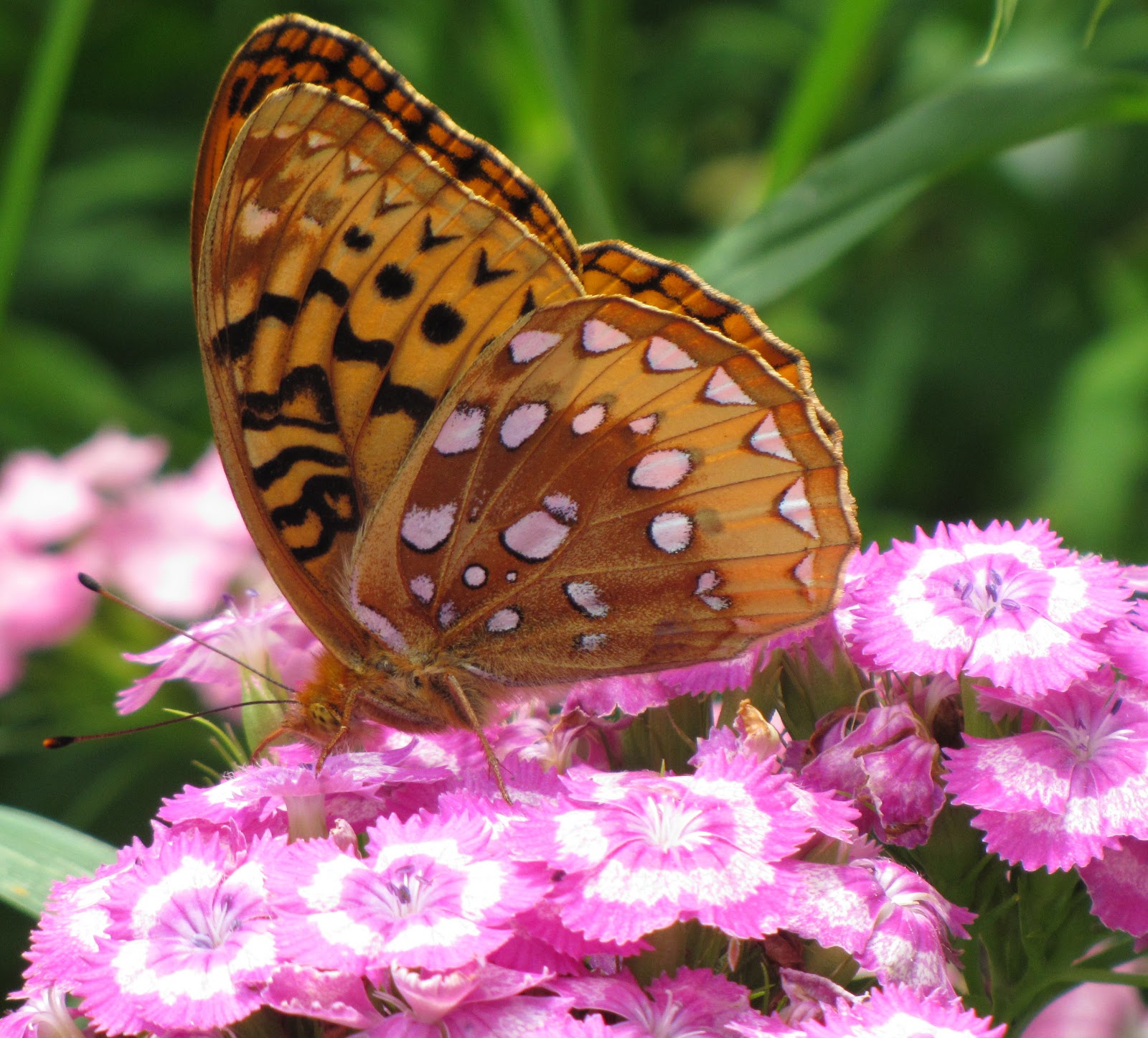
Another beautiful golden butterfly is the fritillairy. In West Virginia, we have a number of different ones including the Great Spangled Fritillary. The scientific name is Speyeria cybele.  Cybele means "mountain mother" or "earth mother".  In late summer the female will lay as many as 2000 eggs on or near violets.  In the fall, the eggs hatch, but the caterpillars go to sleep without eating and wake in the spring when they begin to feed on the young violet plants.  Scientists are researching to see if global warming might change the timing and thus the result could be devastating for the hungry caterpillars.


This picture of a fritillary taken earlier in the summer plainly shows the spots on the under wing.  Appalachian folklore claims that if you catch the butterfly and count the spots, that is how much money you will come into.  It's easy to imagine children of earlier times enjoying this fantasy.


This aging and battered butterfly is called a Buckeye. Like its cousin the Monarch, it migrates south for the winter.


A pretty, but tiny butterfly is this Pearl Crescent sitting on a Brown-Eyed Susan. The female lays her eggs on asters. Its wingspan is only 1.25 to 1.5 inches. Look closely or you may not see it.


Something about the underside of this butterfly makes it seem grotesque. Possibly it's because the rotten pear that it is eating, just doesn't seem that appealing. Supposedly, they will even get a bit tipsy from eating fermented fruit which results in their erratic flight.


When it opens it wings, the surprise is to see a beautiful and colorful butterfly called a Red Admiral. These butterflies are said to be both territorial and attracted to perspiration. If you are lucky, they will land on your shoulder.


This fuzzy little butterfly almost has a teddy bear like quality to its head. It is a skipper, and unlike other butterflies, it holds its wings separately when puddling as can be seen in the picture below.


This white butterfly looks so dainty against the purple asters.  Unfortunately, it is the dreaded cabbage butterfly that is a plague to gardeners. The species came to North America from Europe around the time of the Civil War.  The two spots on the upper wing of this one indicate that it is a female.  Males  have only one spot.

Finally, we have the regal Eastern Tiger Swallowtail. The female may look like the one below or even be dark like the Pipevine Swallowtail. An interesting fact about this species is that when the caterpillar first hatches, it is camouflaged to look like bird poop.


"Just living is not enough" said the butterfly, "one must have sunshine, freedom and a little flower." Hans Christian Anderson

This is a good message for all of us.

Thursday, October 27, 2011

The Return of Courage


On October 15, Courage our deer with the injured leg returned.  She had been missing for six days following a period of very heavy vehicle traffic on the previous Sunday. Sadly, one of her twin fawns had died about three weeks earlier after being hit by a car.  Even after it's death, Courage and her remaining fawn were daily visitors to our yard.  

Several times I had scanned the sky on our side of the mountain for signs of any of the carrion eaters: ravens, crows and vultures that screech out the news of a death. There were none. 

Courage's remaining fawn returned to our yard several times a day, sometimes obviously waiting for her. Below, he looks like a miniature adult dwarfed by interrupted fern and large hosta leaves.


Here is a closeup of his head.  Looking at it closely, you can see the brown spot between his ear and eye where he will someday have horns.


Six days after her disappearance, the little buck was lingering in our yard, sampling the flowers in my garden.  On the other side of the garage out of his view, I saw Courage, at long last, making her way slowly down the hill.  I was so happy to see that she was still alive. I watched to see the reunion, and suddenly, the little one was beside her excitedly trying to nurse.


Because most fawns are weaned by the time their spots are gone, the little one began to wear out his welcome.  Courage kept moving every time he nuzzled her.  Eventually, a little nip sent him to a clump of grass where he began to eat grown-up food.


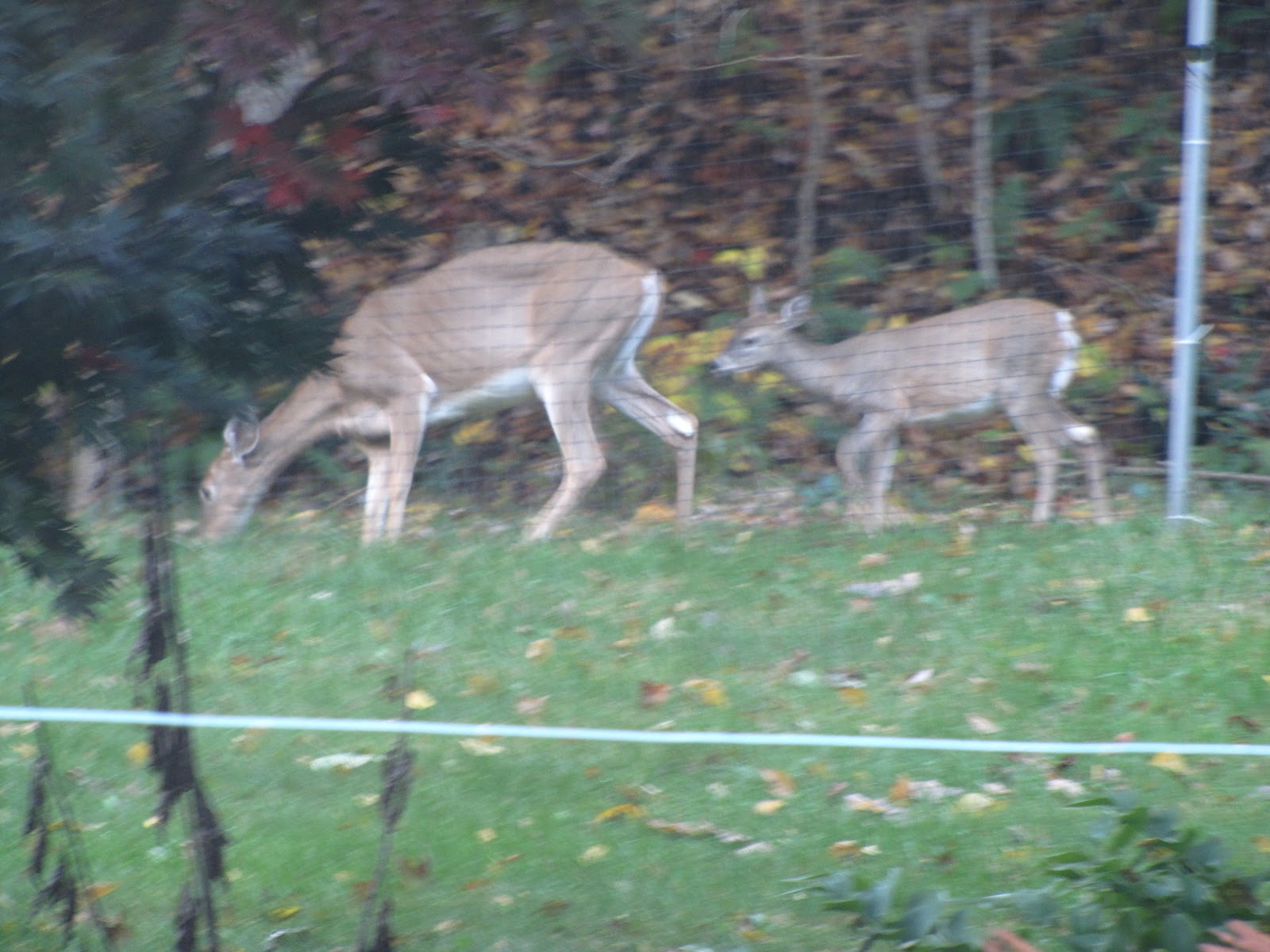
Courage and her fawn now show up late every afternoon, lingering sometimes until almost dark.  She continues to lie down outside of our fence while he slips in through the hole that we haven't yet fixed.  Below, Courage grazes and can be partially seen although the Japanese Maple blocks most of her from our view.


This little deer has become a regular visitor to our garden.  Today, I pounded on the window when I saw him browsing from a container in which I had just planted pansies.  Like a cartoon character, he looked up with a yellow pansy dangling from between his teeth.  I finally opened up the porch door and soundly scolded him for his choice of snacks.  Totally unafraid, he obliged by moving away from the pansies and began feeding on some lily leaves that will soon fall victim to a freeze anyhow.


I realize that someday, he may become a major nuisance to us, but for now, he is just so darn cute. It's for special moments like these, that I was so irresistibly drawn back to these mountains and rural life.